How an operator-branded AI service is built and deployed
The AI Agent Platform connects subscriber conversations to the operator’s network, business systems and digital channels. This guide explains the architecture, integration, management controls, hosting options and delivery responsibilities behind the service.
Platform architecture
An AI model is one component of the service. A subscriber product also needs network connections, a dedicated agent for each subscriber, conversation context, permitted actions, notifications, charging and day-to-day operations. The AI Agent Builder brings these application functions together and connects them to the operator’s network and business systems.
AI Agent Platform architecture
Open full-size diagram ↗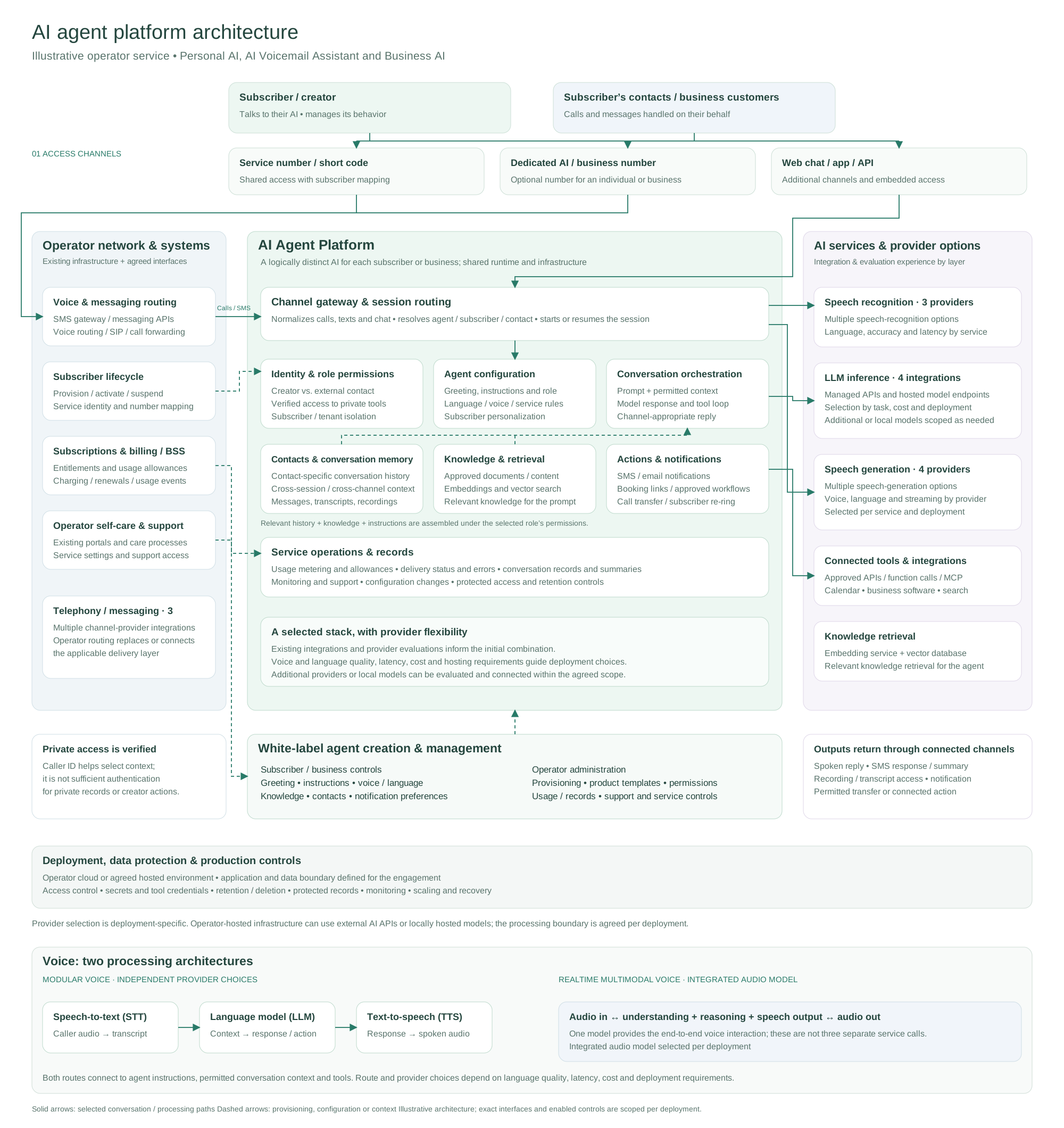
The platform supplies subscriber-specific agents, saved behavior, contact context, conversation memory and permitted actions. Speech and language services connect to that application layer; the operator’s network supplies the access path.
Layer-by-layer functions and responsibilities
Network access and real-time voice
Channel and call routing
- Service numbers and short codes
- Conditional call forwarding
- SMS, web chat and API connections
Gets the call or message to the correct service and preserves the identifiers needed to handle it.
Operator network + platform adaptersReal-time audio handling
- Audio streaming
- Turn detection and interruptions
- Call state, transfer and fallback
Coordinates listening, speaking and call handling so the experience works as a conversation.
Voice service + network handoffSpeech recognition · STT
- Audio-to-text transcription
- Launch-language and accent testing
- Noise and caller-name handling
Turns what the caller says into text the agent can use, with quality assessed for the launch market.
Selected speech model + platform
Intelligence and personalized agents
Language-model inference · LLM
- Response generation
- Context and prompt assembly
- Model selection and usage cost
Interprets requests and produces responses using the agent’s instructions, available context and tools.
Selected language model + platformSpeech generation · TTS
- Text-to-audio synthesis
- Voice, language and speaking style
- Streaming playback
Gives the assistant its spoken voice, selected alongside latency, language quality and cost.
Selected voice model + platformSubscriber agent management
- Dedicated agent per subscriber
- Saved greeting and instructions
- Behavior and voice configuration
Makes the service a personal assistant rather than one generic bot shared by every subscriber.
AI Agent Builder
Identity, context and useful actions
Identity, contacts and permissions
- Intended-subscriber mapping
- Contact context
- Verified creator and team access
Distinguishes the subscriber from outside callers and controls who can review data or manage the agent.
Platform identity + operator identifiersConversation memory and knowledge
- Persistent conversation history
- Cross-session and cross-channel context
- Document retrieval and approved knowledge
Supports follow-up calls and texts, recognizes prior context and answers from relevant service or business information.
Platform records + retrieval servicesTools and workflow execution
- Approved API and tool calls
- Booking and follow-up workflows
- Permissions and action results
Moves beyond answering questions to completing permitted tasks and recording their outcome.
Platform orchestration + connected systems
Subscriber product and commercial control
Records and notifications
- Recordings, transcripts and summaries
- SMS and email notifications
- Protected links and retention
Turns a completed conversation into an accessible record and a useful next step for the subscriber or team.
Platform + storage and delivery interfacesSubscription and usage control
- Activation, renewal and cancellation
- Entitlements, allowances and limits
- Usage metering and charging events
Connects access to the subscriber’s offer and keeps product usage aligned with the operator’s charging rules.
Platform controls + operator BSSWhite-label self-care and workspaces
- Subscriber personalization
- Business tenants and team permissions
- Operator management and reporting
Provides the interfaces to personalize an assistant, manage a business service and operate the subscriber offering.
Platform interfaces + operator digital channels
Shared operational foundations
- Hosting, security and data
- Application services, databases, storage, network access, credentials, subscriber and tenant isolation, retention and deletion. Application hosting and model-processing locations are agreed separately.
- Reliability and cost control
- Capacity, monitoring, error handling, delivery retries, routing fallback, usage limits, incident response and recovery. These need end-to-end testing across the platform, model providers and operator interfaces.
- Product quality and operations
- Native-language review, prompt and voice tuning, representative test calls, controlled releases, support ownership and measurement of subscriber use and delivery cost.
Calls use the audio, speech-recognition and speech-generation layers; SMS and web chat enter through their messaging interfaces. Both use the same agent, identity, context and service controls. A speech-to-speech model can combine parts of the voice pipeline; the surrounding product layers still remain.
What the build-versus-partner decision includes
An internal build means integrating and operating this whole service: selecting models, maintaining subscriber agents and context, connecting network and billing systems, delivering records, and supporting the product as usage grows. Technology licensing provides an existing application platform with scoped integration. A managed partnership adds hands-on product development, launch and ongoing operations alongside the operator’s team.
The operator supplies network routing, numbers, subscriber systems and carrier-side access. We provide the AI application platform and agreed integration; speech and language processing use selected external or locally hosted models. Enabled functions and operational responsibilities are established for the chosen product and deployment.
Operator integration
The conversation path and the subscriber’s service entitlement must stay connected. The network identifies the destination and intended subscriber; the AI platform applies that subscriber’s agent, context and permitted actions. Provisioning and charging determine whether and how the service can be used.
Connect conversations
Voice routing and the SMS gateway pass calls, messages and identifiers to the correct subscriber’s AI. Replies, summaries and permitted transfers return through the connected channels.
Connect the subscriber lifecycle
Activation provisions the agent and its entitlement. Renewals, allowances, suspension and cancellation keep access aligned with the operator’s subscriber record.
Connect usage and actions
Usage events support carrier charging and reconciliation. Calendar and business workflows use the approved systems, credentials and permissions included in the service.
Our team configures the AI application and agreed adapters alongside the operator’s network, billing and digital teams. An existing development partner can supply or maintain the operator-side interfaces.
Interface reference: SMSC, voice, provisioning, BSS and business systems
| Interface | Information exchanged | Integration detail |
|---|---|---|
| SMS gateway / SMSC | Mobile-originated (MO) text, sender and service identifiers; mobile-terminated (MT) replies and available delivery events. | Gateway API or messaging protocol, short code/number, encoding and segmentation, throughput, delivery handling and retries. |
| Voice routing | Forwarded or direct calls, media, caller and intended-subscriber identifiers, call-state events and handoff destinations. | Forwarding or network handoff, supported audio/signaling path, subscriber mapping, busy/unreachable behavior and fallback. Test urgent re-ring paths to avoid forwarding loops. |
| Provisioning and entitlements | Activation, agent settings, plan eligibility, allowance, suspension, renewal and cancellation events. | Authoritative subscriber record, agent creation/update, lifecycle APIs or callbacks, event ordering and duplicate-event handling. |
| Billing / BSS | Usage records, charge or subscription outcomes, balances and entitlement status where exposed. | Retail charging owner, metering units, renewal outcomes, reconciliation and behavior when entitlement or billing is unavailable. |
| Self-care and notifications | Subscriber settings, summaries, recording/transcript access and delivery events. | SMS, operator app, web or optional USSD account management; authenticated access, delivery destinations and cancellation controls. |
| Business tools | Authorized workflow requests and results, such as booking links, intake records or follow-up actions. | System/API access, tenant permissions, approval rules, credentials, audit events and handling of failed or repeated actions. |
These are integration areas, not a claim that every carrier interface is interchangeable. The technical team confirms available APIs, messaging protocols, voice handoff and any required adapters. SMSC means Short Message Service Centre; BSS means business support systems. USSD is an optional account-management channel, not a prerequisite for AI conversations.
Management and control
The operator can offer the agent-management interface under its own brand. Subscriber personalization, business workspaces and operator administration expose the controls appropriate to each service and role.
Network activation and optional self-care
Personal AI and AI voicemail are natural add-ons to the services an operator already delivers: phone numbers, calls, SMS, subscriber accounts and billing. Your existing activation process can provision the subscriber’s AI and usage entitlement in the background. Subscribers can call or text without downloading an app or creating a separate AI account.
- 01Activate through the operator
- 02Provision the AI and allowance
- 03Use calls and SMS
A white-labelled web portal adds self-care under your brand. Subscribers personalize their AI’s greeting, instructions and available voice or language settings in a browser. The operator selects the controls and permissions included in the service. The portal can be introduced alongside launch or as a later service enhancement.
For business subscribers, the same customer-facing platform becomes a branded workspace for configuring agents, knowledge and notifications, reviewing conversations and managing authorized team access.


- Subscriber self-care
- Personal greeting, saved instructions and the personalization options enabled for the subscriber’s plan.
- Business workspace
- Agent knowledge, notification preferences, conversation review and team controls, governed by workspace permissions.
- Operator administration
- Service defaults, provisioning, entitlements and which capabilities each subscriber or business can access.
Identity across conversations
A service number or short code identifies an entry point, not necessarily a unique assistant. Forwarded calls must preserve enough information to map the intended subscriber. Creator and team access require appropriate verification and permissions; caller ID alone must not unlock private conversation history or management tools.
Agent instructions and contact-specific context guide the conversation. Creator and authorized team access open management and private-data functions; external callers receive the behavior and actions configured for their role.
Hosting and data
The application and its records can run in an agreed hosted environment, the operator’s cloud or a hybrid arrangement. Deployment includes the application services, databases, transcripts and recordings—not only a front-end interface.
| Arrangement | Application and records | Delivery requirements |
|---|---|---|
| Hosted service | Application services and conversation records in our agreed hosting environment. | Data-processing terms, region, access, connectivity and the operator interfaces exposed to the service. |
| Operator cloud | Application, databases, transcripts and recordings in the operator’s Azure, AWS, GCP or other agreed environment. | Cloud access, network connectivity, deployment ownership, capacity, security review and ongoing operations. |
| Hybrid | Selected components remain with the operator while agreed services run in another environment. | An explicit data-flow map showing each boundary, permitted data transfers and operational ownership. |
Application hosting and AI processing
Application hosting and AI processing are separate decisions. Speech recognition, language-model inference and speech synthesis may each use external services or locally hosted models. An operator-cloud application can still send data to an external model provider. A fully internal processing design needs a validated model for every required layer, with language quality, latency, capacity and licensing reviewed together.
Access, retention and operational controls
- Access and isolation
- Define subscriber and business-tenant boundaries, creator/team permissions, service access and privileged operations.
- Records and retention
- Identify what is recorded, where it is stored, who can open links, how long records remain, and how deletion and any backups are handled.
- AI and tool access
- Define which conversation data can reach each processor or tool, permitted actions and destinations, and any approval requirements.
- Operations and recovery
- Agree monitoring, usage/capacity limits, incident ownership, release and rollback procedures, fallback routes and support coverage.
Deployment and responsibilities
Our delivery team takes the agreed service through configuration, network integration, internal testing and a controlled subscriber POC. Product and language tuning continue through the pilot, followed by production readiness and staged activation.
From configuration to launch
- 1
Scope
Choose the service, cohort, language, interfaces, environment, commercial scope and project owners.
- 2
Connect
Configure agents, routing, subscriber mapping, provisioning and records/notifications.
- 3
Validate
Complete internal language, access, routing, charging and failure-path tests.
- 4
Pilot
Observe real use and refine quality, packaging and delivery economics.
- 5
Launch
Complete production acceptance, support readiness and staged subscriber onboarding.
Initial configuration and integration can target two to four weeks once scope, access and the environment are ready. The subscriber POC has a separately agreed evaluation period. The launch schedule reflects the integration scope, cloud setup and operator approvals.
Who delivers what
The operator supplies its brand, subscriber channels, network and carrier-side access. We supply the AI platform and agreed application integration. Technology licensing supports an operator-led product; a managed partnership adds hands-on product, launch and operating work.
Existing software vendors and development partners can remain part of delivery. Responsibilities are allocated around the operator’s team and the engagement scope.
Responsibility matrix: licensing and managed partnership
| Workstream | Operator contribution | Technology licensing | Managed partnership |
|---|---|---|---|
| Product and retail offer | Target segments, brand, pricing and subscriber proposition. | Platform capability guidance and scoped technical delivery. | Joint product definition, packaging and ongoing iteration. |
| Network and billing | Numbers, routing, interfaces, access and carrier-side implementation. | Agreed AI-side integration and technical support. | Coordinated integration delivery; carrier-side ownership remains with the operator. |
| Security and hosting | Security requirements, approvals and resources for operator-hosted components. | Agreed application deployment and control configuration. | Hands-on deployment coordination and operational management within scope. |
| Launch and distribution | Subscriber channels, campaigns, retail teams and launch approvals. | Technology support for the operator-led launch. | Joint GTM planning and execution using operator distribution. |
| Service operations | Subscriber support, carrier operations and escalation contacts. | Platform maintenance and scoped support responsibilities. | Product and technology operations as agreed, with a shared support/escalation plan. |
Both models support a white-labelled product under the operator’s brand. Licensing is a technology-vendor engagement; a managed partnership adds product and execution responsibilities. Platform, usage and any revenue-share terms are agreed privately. The responsibility matrix is a starting point for scoping, not a contractual service-level agreement.
What the POC covers
| Area | What we test together | Evidence for launch |
|---|---|---|
| Language and conversation quality | Representative requests, names, accents, noise, interruptions and the selected voice. Use native speakers for launch-language evaluation. | Reviewed samples and agreed quality thresholds for the intended use cases. |
| End-to-end routing | Direct and forwarded calls, busy/unreachable conditions, subscriber mapping, SMS delivery and urgent re-ring where offered. | Correct agent selection, successful notifications and tested failure paths without routing loops. |
| Identity and data access | Creator, team and outside-contact roles; cross-tenant access attempts; record links, retention and deletion. | Expected access succeeds and unauthorized access is rejected under the agreed test plan. |
| Entitlement and charging | Activation, allowance exhaustion, renewal, cancellation, retries, duplicate events and unavailable billing interfaces. | Consistent service eligibility, usable usage records and reconciled billing outcomes. |
| Performance and resilience | Time to first reply/audio, response continuity, concurrent sessions, provider failures and agreed load profiles. | Measured latency and capacity, observable failures and working fallbacks against agreed targets. |
| Subscriber and commercial value | A defined cohort using the service over an agreed evaluation period. | Activation, repeat use, useful outcomes, paid behavior where tested, support needs and delivery cost. |
Inputs for the first scoping discussion
The first conversation can start with the information already available; our team helps develop the remaining scope.
- First subscriber segment and the problem to solve
- Starting product, access channel and launch languages
- Target launch date and internal decision process
- Expected pilot cohort, usage range and retail packaging
- Available network, billing, provisioning and self-care interfaces
- Hosting, data-location and security requirements
- Product, network, billing and security contacts
- Budget, preferred engagement model and acceptance criteria